Download
part of track
When you enter a room and hear classical music
sounding you unconsciously realize its place in the entire work.
Is it the cadenza, the exposition or the development? You know your
body and know where each part should be. Legs usually don't grow
from the head and we usually don't confuse the head with another part of
the body. Everything bears a sign of
its place. We read these signs and evaluate them. This idea
is fundamental for many compositions by
Alfred Schnittke
(1934 - 1998). When the next section of musical form is due - you
may insert music of a different style and epoch. If it bears an appropriate
'sign of place' it will work!
Symphony No. 3
by Schnittke is a perfect example of exploiting the 'sign of place' idea.
You may count over a dozen different styles used in this work. 'Sign
of place' developed Schnittke's polystylism much earlier than Symphony
No. 3 was composed and it affected musical forms much more than other elements
of his musical language.
Schnittke's forms don't follow the classical
standards. Instead they display a 'counterpoint of logical structures',
which seems to be the most universal approach to the analysis of any style.
'A logical structure' means more than just musical material. The
term also applies to emotions, illusions and ideas. In this case
the same 'structures' - the same meaning - can be expressed by different
musical means.
I realize how disappointing my theory is for
the followers of monothematism. Reality displays the existence of
many concepts of integrity different from theories by Aristotle and Beethoven.
Symphony No. 3 is one of the most monumental
works by Schnittke. It was written on the occasion of the Leipzig
"Gewandhaus"orchestra jubilee and opening of the new "Gewandhaus" concert
hall. The premiere took place there on November 5, 1981, and was
conducted by Kurt Mazur with tremendous success. In the Soviet Union
the Symphony was
first performed by the USSR Ministry of Culture Symphony Orchestra under
Gennady
Rozhdestvensky
in the autumn of 1982.
Gennady Rozhdestvensky, USSR People's Artist,
Lenin Prize Winner, is an outstanding
musician of today. An artist of universal ideas and wide artistic
interests, Rozhdestvensky
has paid tribute to the art of the 20th century and mostly to Russian
music, works of his
contemporaries, from the very beginning of his career. He premiered
and recorded many
symphonic compositions by Schnittke.
A new method of organization of musical material
is represented in my own
Symphony No. 3
. I call it "synchronous music". Though synchronous music
demonstrates a new artistic result, the idea of the simultaneous unfolding
of two or more compositions is at least several centuries old. We
can hear it in double and triple fugues by J.S.Bach, in "Marriage of Figaro"
by Mozart, in works by Charles Ives.
You may ask: "Is there any limit to the number
of compositions that may be heard at the same time?" I would answer:
"Yes. It is determined by the limit of our perception. Any
detail, which cannot be distinguished and perceived is defective and demonstrates
a lack of the composer's professionalism". Many would ask "How can
I perceive this complex music?"
I would answer, that you don't need any help. Synchronous music would
not survive if you would need any assistance.
No one can focus their attention on more than
one thing at the same time. Always our perception follows only one
major layer of musical texture. If the prioritized material switches
from one layer to another our attention follows this change. So while
listening to synchronous music your perception will bounce between different
compositions sounding at the same
time and this shifting will evoke remarkable emotions and experiences.
The same way you listen to fugues - your attention switches from one entrance
of a theme to another. We unconsciously track these musical events.
The 'tracking list' is remarkably rich and long in works written in the
synchronous music style. Time and information are compressed.
I individualized the different works which make
up the texture of Symphony No. 3 by different tempi, timbres, forms,
often styles and used eight extra sub-conductors to lead the choir, different
ensembles and groups inside the orchestra. Of course, there is always
a principal conductor. He shapes the architecture of the entire work
and interprets it.
The fact that synchronous music is no longer
an experiment sets it apart from previous attempts made in this direction. Synchronous
music is a new style which demonstrates a new method of organization of
musical material. It applies to all elements of musical language
and establishes a new tradition to compose, perform and listen. Synchronous
music is perfect
to portray the versatile, polyphonic nature of the modern world.
To create an all-embracing view is the fundamental idea of every composer
writing symphonies.
Alfed Schnittke (1934 - 1998)
Symphony No. 3
1. Moderato - 13:55
2.
Allegro - 12:45
3.
Allegro Pesante - 8:04
4. Adagio - 18:47
Evgeni Kostitsyn (b. 1963)
Symphony No. 3
5.
Symphony No. 3 - 19:01
Total Time - 72:41
Alfred Schnittke. Symphony No. 3
The USSR Ministry of Culture Symphony Orchestra
Conductor - Gennady Rozhdestvensky
Recorded in 1984
Recording engineers:
Veprintsev and Buneyeva.
©1990 Gramzapis
©2002 CDK Music
Evgeni Kostitsyn. Symphony No. 3
Kiev Philharmonic Symphony Orchestra
National Choir of the Ukraine "Dumka"
Choir Master - Victor Petrichenko
Conductor - Evgeni Kostitsyn
Recorded in 1997
Recording engineer - Vikharev
©1997 Evgeni Kostitsyn
©2002 CDK Music
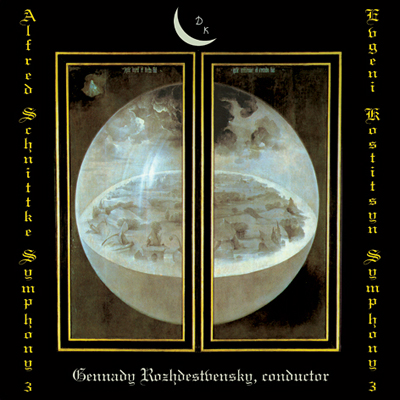
cover painting - "The Garden of Earthly Delights" by Hieronymus Bosch