Download
part of track
Vasily Sergeyevich Kalinnikov
(1866 - 1901), the Russian romantic composer,
was born in Voina, Oryol District, in the family of a police officer.
The poverty of his family made it impossible for him to study at the conservatory
and forced him to make a living playing bassoon, violin and timpani in
different amateur orchestras.
He was poor and sick with tuberculosis. His name
was known well only among members of his family. After receiving
a scholarship at the School of the Philharmonic Society in 1884, in 1892
with the recommendation of Tchaikovsky he managed to get the position of
conductor at the Maliy Theatre in Moscow, and later at the Moscow Italian
Theatre.
Unfortunately his disease forced him to resign shortly
after this appointment and move to Yalta, a sea resort in the Crimea.
Rachmaninov, visiting Kalinnikov was appalled by the conditions in which
he found him living. Towards the end of his life, Kalinnikov received
some financial relief through the good offices of Sergei Rachmaninov, who
also introduced Kalinnikov's compositions to his publisher Jurgenson.
The death of the 34-year-old composer induced Jurgenson
to offer Kalinnikov's widow an unexpectedly high sum for her husband's
manuscripts, with the remark that he paid because the composer's death
had multiplied the value of his works by ten. You may see, that nothing
has changed in the music industry in a hundred years - the dead composers
are much more welcome than alive!
Kalinnikov's First Symphony,
the best known composition by him, was written during 1894 and 1895,
and was dedicated to one of his teachers and friends Semyon Kruglikov.
It was premiered in 1897 in Kiev, and shortly after that - in Moscow, Vienna
and Berlin. It is amazing after reading his biography to find skillful
counterpoint in the development sections, rich colourful orchestration
and no clichés in the tutti. All polyphonic lines are individualized
by different timbres, which allow hearing of the smallest details of the
orchestral texture. Symphony #1 demonstrates the mastery of the composer and his great spirit.
It belongs to the best samples of Russian symphonic music.
Rimsky-Korsakov, Nikolai
(1844 - 1908) is a celebrated Russian composer and theorist. His family
was preparing him for a naval career. He became a naval officer and
undertook a round-the-world trip on the clipper "Almaz".
Rimsky-Korsakov absorbed numerous impressions from the journey and many
of these impressions were turned into his music later.
Though Rimsky-Korsakov met Balakirev and joined
the "Mighty Five" in 1861, his real development as a composer
started after his return from the round-the-world trip to Saint-Petersburg.
The completion of his First Symphony under the supervision of Balakirev
and the successful premiere of this composition became a pivotal moment
in his final determination to pursue a career as a composer. After
resigning from the navy, Rimsky-Korsakov was 27 when he received an invitation
to teach at the Saint-Petersburg Conservatory. Being a great composer himself Rimsky-Korsakov also taught Stravinsky, Prokofiev and Shostakovich. He
together with Glazunov finished and orchestrated "Prince Igor"
after the death of Borodin and made the final edition of "Boris Godunov"
after the death of Mussorgsky. The Saint-Petersburg conservatory now bears the name of Rimsky-Korsakov.
It was common for Rimsky-Korsakov to revise his
compositions many times. His first opera "The Maid of Pskov" written in 1871 after Lev Mei's melodrama with the same name,
was revised in 1877 and, the third time, in 1894. Working on the
third edition, Rimsky-Korsakov decided to compose "The Noblewoman Vera Sheloga" - the one-act opera based on the introduction to Mei's melodrama.
The introduction tells a story of the maid's mother - a noblewoman Vera
Sheloga and her father - Tsar Ivan the Terrible. The maid was their
illegitimate child. Both operas are represented in our programme
by overtures, and orchestral episodes from "The Maid of Pskov".
The unique feature of "The Maid of Pskov"
is that this opera was written at the same time (1871), in the same room,
and at the same table with the second version of "Boris Godunov"
by Mussorgsky. Being room-mates the composers had very similar musical
ideas and we can recognize it in their music. Topics taken from Russian
history were also very similar. This is an example of the unique
phenomenon of "twin operas"!
Evgeni Svetlanov
(1928 - 2002) was born in Moscow. He studied piano with Maria Gurvich,
composition with Mikhail Gnessin and Yuri Shaporin and conducting with
Gauk. After graduating from the Gnessin Institute and Moscow
Conservatory he joined the staff of the Bolshoi as a principal conductor
(1963 - 1965). In 1965 he became a leader of the USSR Symphony Orchestra and was in this position till 2000.
In 1979 Svetlanov received appointment as principal
guest conductor at the London
Symphony Orchestra and the last concert in his life was given in London
in 2002.
Svetlanov received numerous honors and awards:
1968 - People's Artist of the USSR;
1978 - the Order of Lenin; 1983 - Soviet State Prize for Creative Achievements;
1998 -
Order for Meritorious Services to the Nation. He also was awarded
the Paris Grand Prix
for his recording of the complete symphonies by Tchaikovsky.
Svetlanov's work at the position of principal conductor
of the USSR Symphony
Orchestra from 1965 till 2000 resulted in the performance and recording
of almost
the entire Russian symphonic repertoire.
©2003 Evgeni Kostitsyn
Vasily Kalinnikov
(1866 - 1901)
Symphony No. 1 in G minor
1. Allegro moderato - 13:58
2. Andante commodamente - 7:23
3. Scherzo. Allegro non troppo - 7:34
4. Finale. Allegro moderato - 7:55
Nikolai Rimsky-Korsakov
(1844 - 1908)
5. Overture to the opera "The Noblewoman Vera Sheloga" - 5:11
6. Overture to the opera "Maid of Pskov" - 6:12
7. Intermezzo ("Maid of Pskov", Act I) - 1:59
8. Intermezzo ("Maid of Pskov", Act II) - 2:59
9. In the Woods, Tsar's Hunting, Storm, Musical Picture - 7:58
("Maid of Pskov", Act III)
Total Time - 61:29
The USSR Symphony Orchestra
Evgeni Svetlanov, conductor
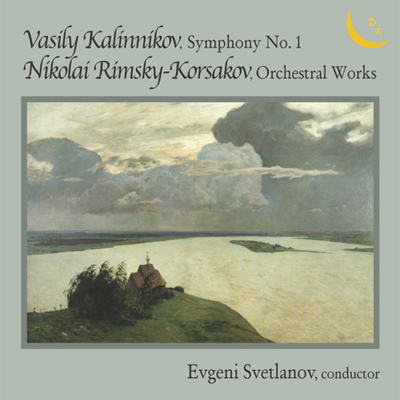
cover painting "Eternal Peace" by Isaac Levitan
Kalinnikov - recorded in 1975. Recording Engineer - Antonenko
Rimsky-Korsakov - recorded in 1985. Recording Engineer - Kozhukhova